

I attribute a large chunk of my personal growth to the seemingly simple practice of writing in a journal.
Everything about my life has improved since I started putting pen to paper. Stronger relationships, better health, a more lucrative career, fulfilling hobbies, goals and purpose. The list goes on.
On the surface, journaling doesn’t seem like it would do a whole lot. Monkey write on paper so monkey feel better? Yes, but journaling is like golf, chess, and meditation—hit ball into hole, capture king, sit and think about nothing. Ogres and onions. Layers. Simple on the surface with a complicated core. Letting the demons spill out onto the pages of a pocket notebook will help with anxiety, sure, but there’s so much more to it than meets the eye—something I failed to notice when I started.
Today, I’m going to talk about those hidden features that only start to make sense once you start. Today I’m going to talk about why you should journal for the rest of your life.
Shall we?
Self Discovery
“In life, the challenge is not so much to figure out how best to play the game; the challenge is to figure out what game you’re playing” - Kwame Anthony Appiah
Most people are abysmal at viewing themselves objectively. They’re overly emotional and sensitive. They lack depth and control. They lack understanding and self awareness. Most people take the hand they’re dealt over and over again without question. They board a random airplane and then get disappointed when they don’t land in Monaco. All because they never really asked themselves who they are and what they wanted in the first place.
Think about how easy it is to see what’s good or bad for someone else. Their shortcomings and strengths are clear. The emotion vanishes and makes room for objectivity and logic. You can tell the boyfriend isn’t right for them. You can see they’re lazy. You see how their addictions work against them. You can see what they can’t. All because you view them from the third person. The solution to the problem—the path forward—is so clear.
Our brains are remarkable at persuasion. Convincing us to stay comfortable. “We need the alcohol.” “She won’t do it again.” Wrong. We are stupid animals. What manifests in our mind is often not reality. We need to learn how to detach, and view ourselves from an eagle eye.
When you write, you’re forced to slow down and articulate what’s actually happening. Not what you’re telling yourself is happening. What do you like? What don’t you like? What gives you energy? What drains it? Where could you be better? What have you been doing well? What are you good at? If you want to change your life, the first step is knowing who you are and what you want. The second step is understanding how you can get there. You wouldn’t expect a monkey to thrive in an aquarium, so why treat yourself any differently? Right now you have no idea whether you’re a sea creature or a jungle cat.
When you write consistently, you begin recognizing patterns in your own behavior. You learn what ideas you should discard and where you should double down. Themes emerge. You iterate until you lab rat your way to the person you’ve always wanted to be.
Patterns
Human beings are pattern recognition machines. We evolved to piece together our environment so as to not get eaten by lions or fall off cliffs. Today, at best, we use it to identify the trendy new bagel shop or the popular, low quality Shein sweater. Journaling lets us resuscitate this ancient skill for something truly beneficial—realizing our own potential. When you write consistently, you inevitably start to make sense of yourself.
Imagine writing this every day for a week:
Monday: was late today
Tuesday: was late today
Wednesday: was late today
Thursday: was late today
Friday: was late today
Lightbulb — “Shit, I’m always late!”
Maybe you notice that every time you hang out with that jabroni Joe Shmo you feel drained? Maybe Greek yogurt gives you a silky smooth complexion? Perhaps you feel better on 7 hours of sleep than 8? Who knows. The point is, your brain is relentlessly looking for ways to connect dots, and journaling serves it up on a golden platter. It forces you to pay attention—you cannot change what you don’t see. It sends the snowball barreling down the mountain and once it gets momentum change is easy. Magically, shaving 5-10 minutes off your morning routine isn’t that hard. You become a mini zookeeper on yourself and the gap between awareness and action shrinks dramatically.
Tracking
“What gets measured gets managed” - Peter Drucker
Writing things down makes them important. We take notes in meetings, concoct grocery lists, and craft hearty to do lists. Journaling, quite masterfully, makes things that are seemingly mundane and useless, a priority. By tracking our habits we can use this to our advantage.
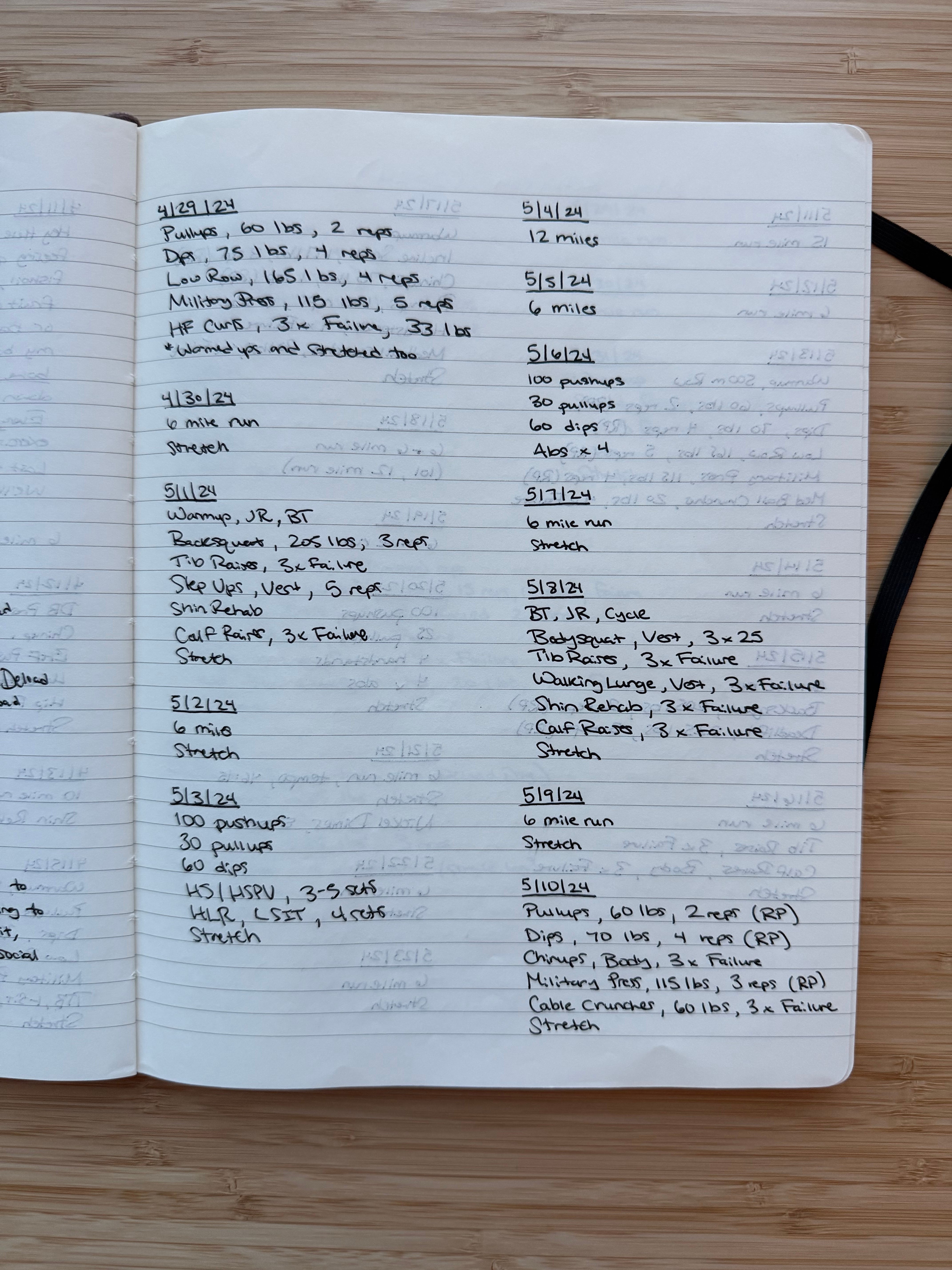
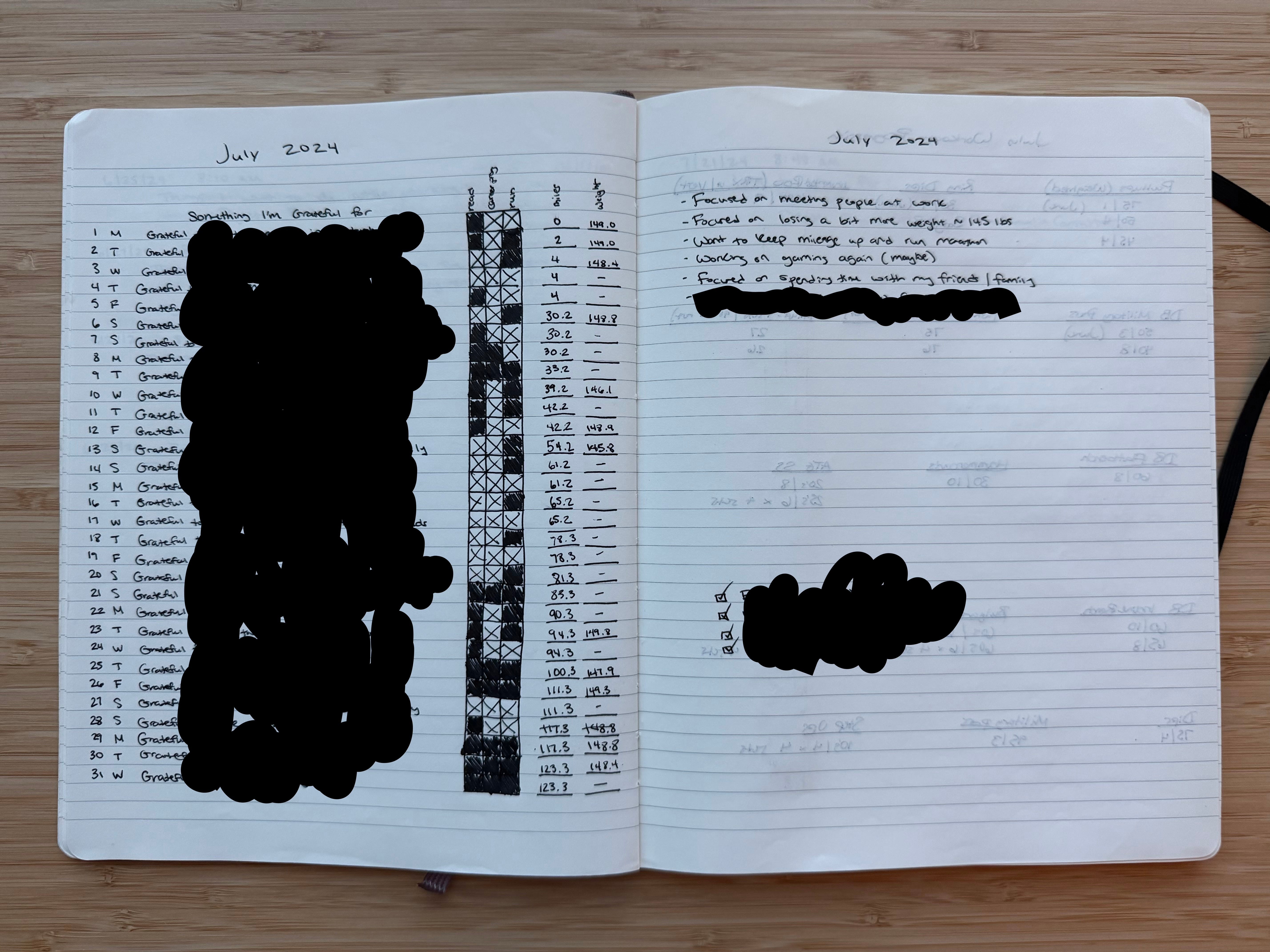
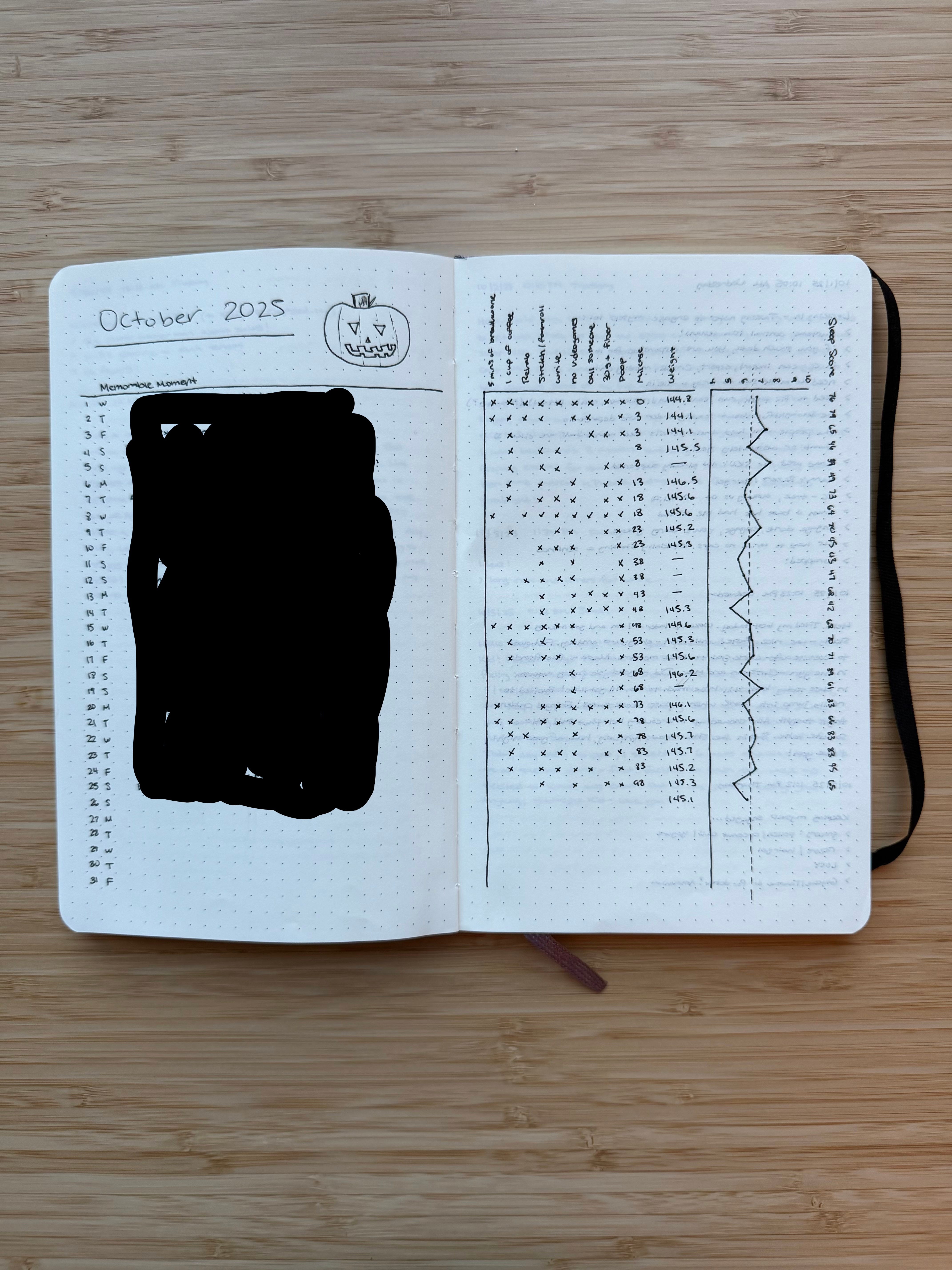
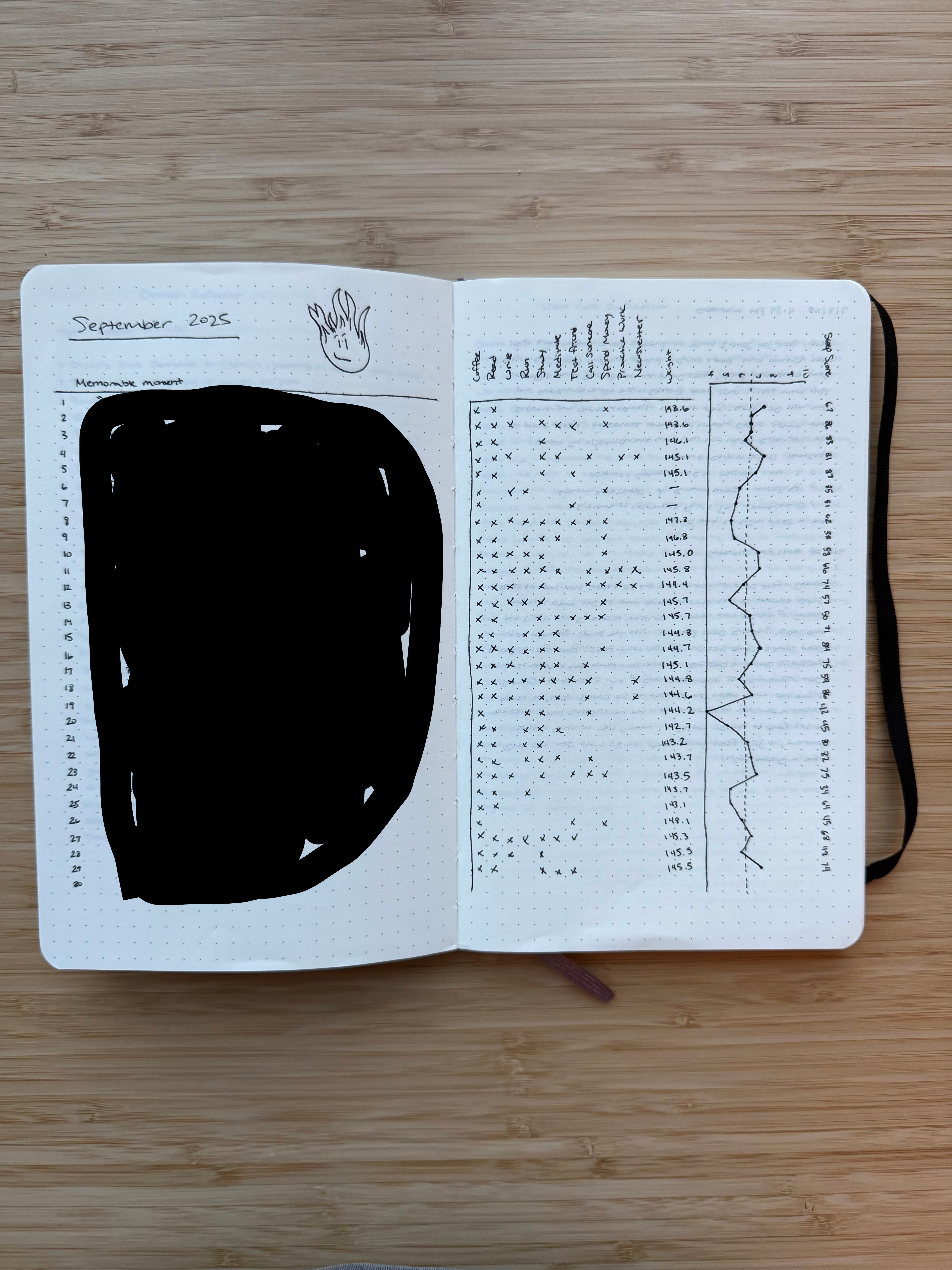
Every morning, I weigh myself and write down my weight—body composition is important to me so I document it. This makes it easy for me to recognize when I haven’t been taking my diet or training seriously. If my weight jumps up over a week or two (and that’s not my intention) then I can rapidly course correct. Most people only track their weight once (at their annual physical) before they realize they’ve gained 15 pounds and now have some serious work to do. Log what’s important to you. Track things that you want to progress in. Even if you fail, it will help you set micro goals and self actualize. How many miles will I run this month? Did I go to the bathroom today? Did I text a friend I haven’t talked to in a while? How many cups of coffee did I have? When did I go to sleep? Did I study Japanese? Did I write? Did I eat my fermented vegetables? Did I study for my interview? Did I spend money today? Did I read?
Frankenstein yourself.
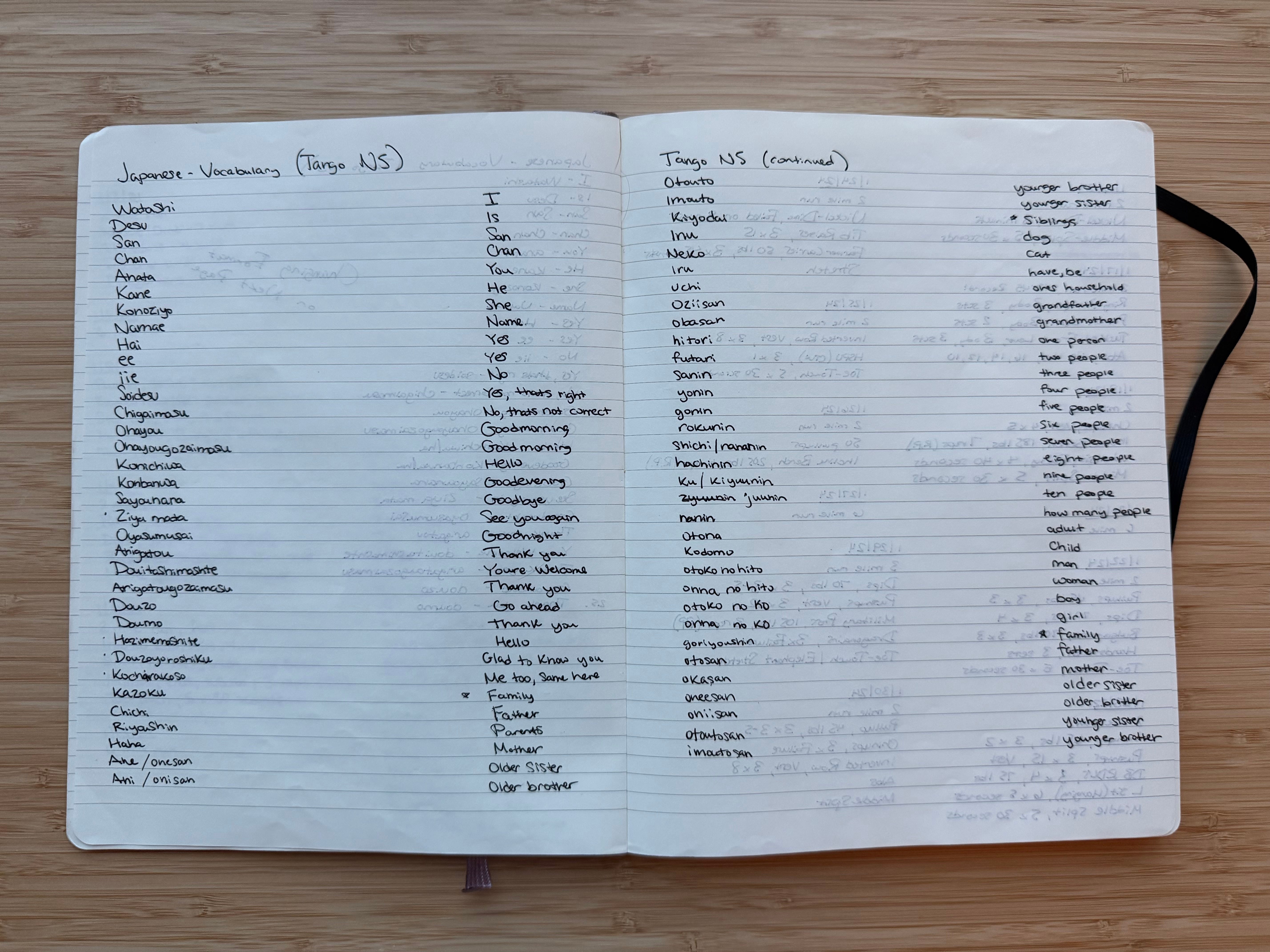
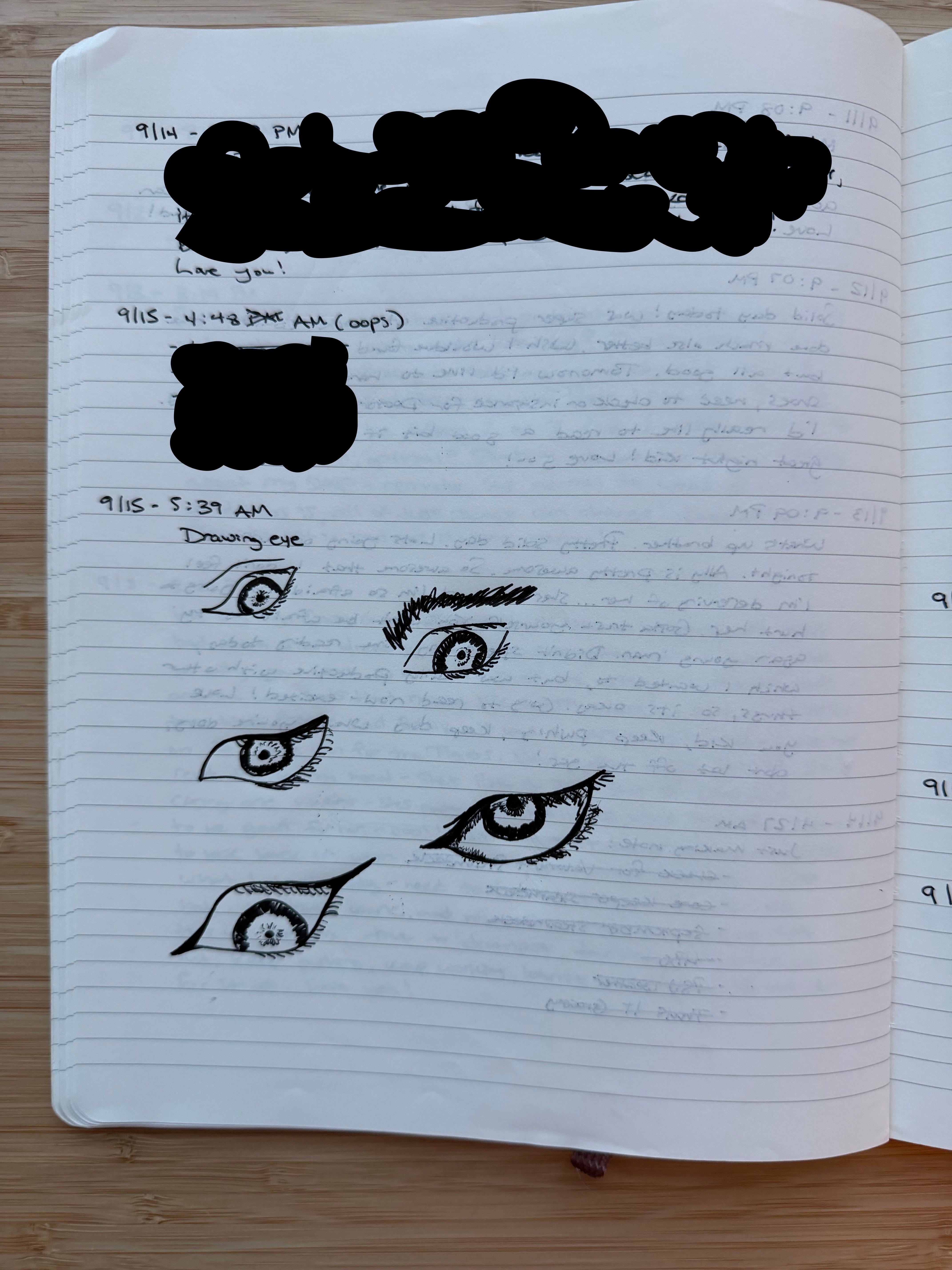
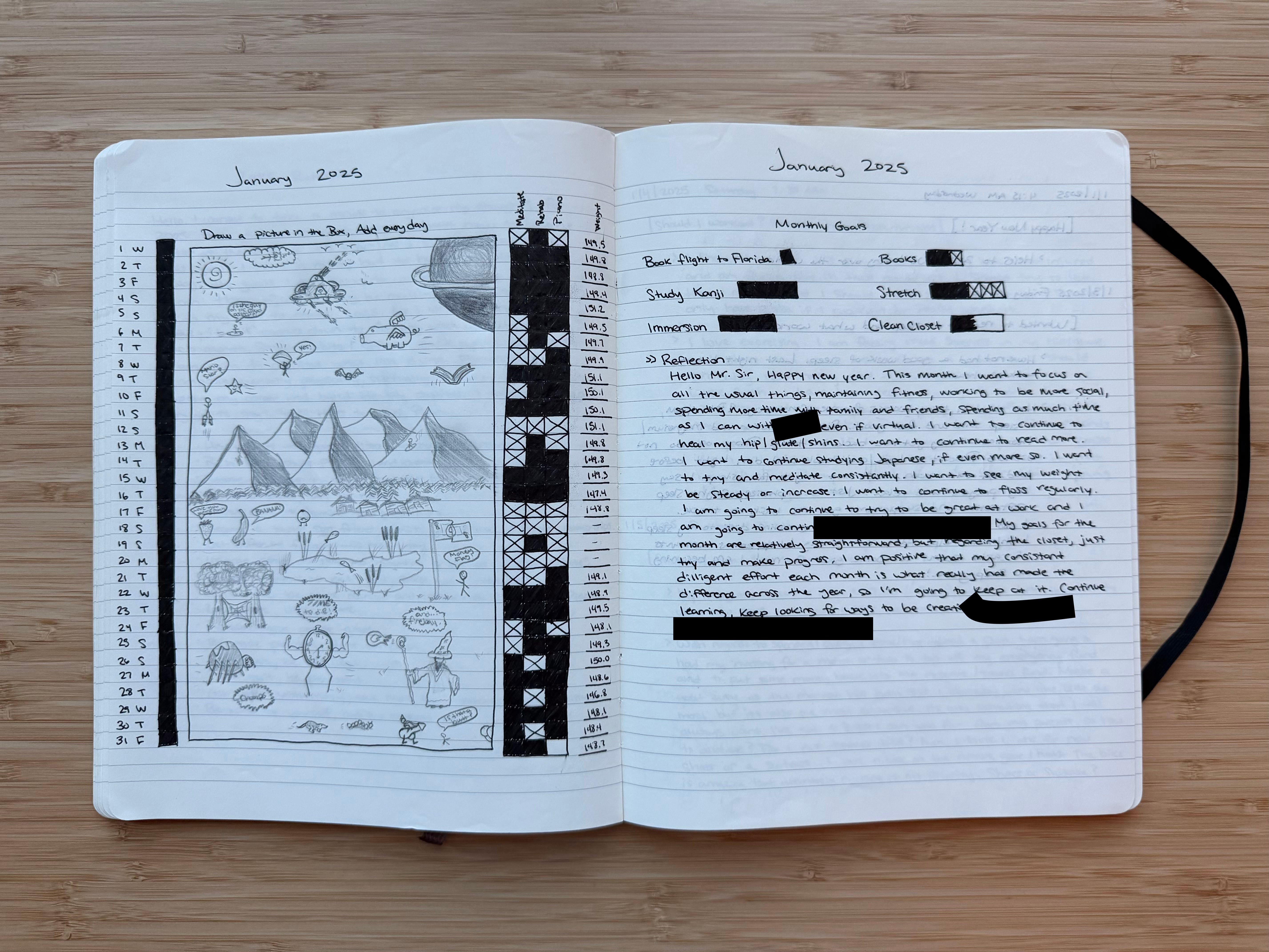
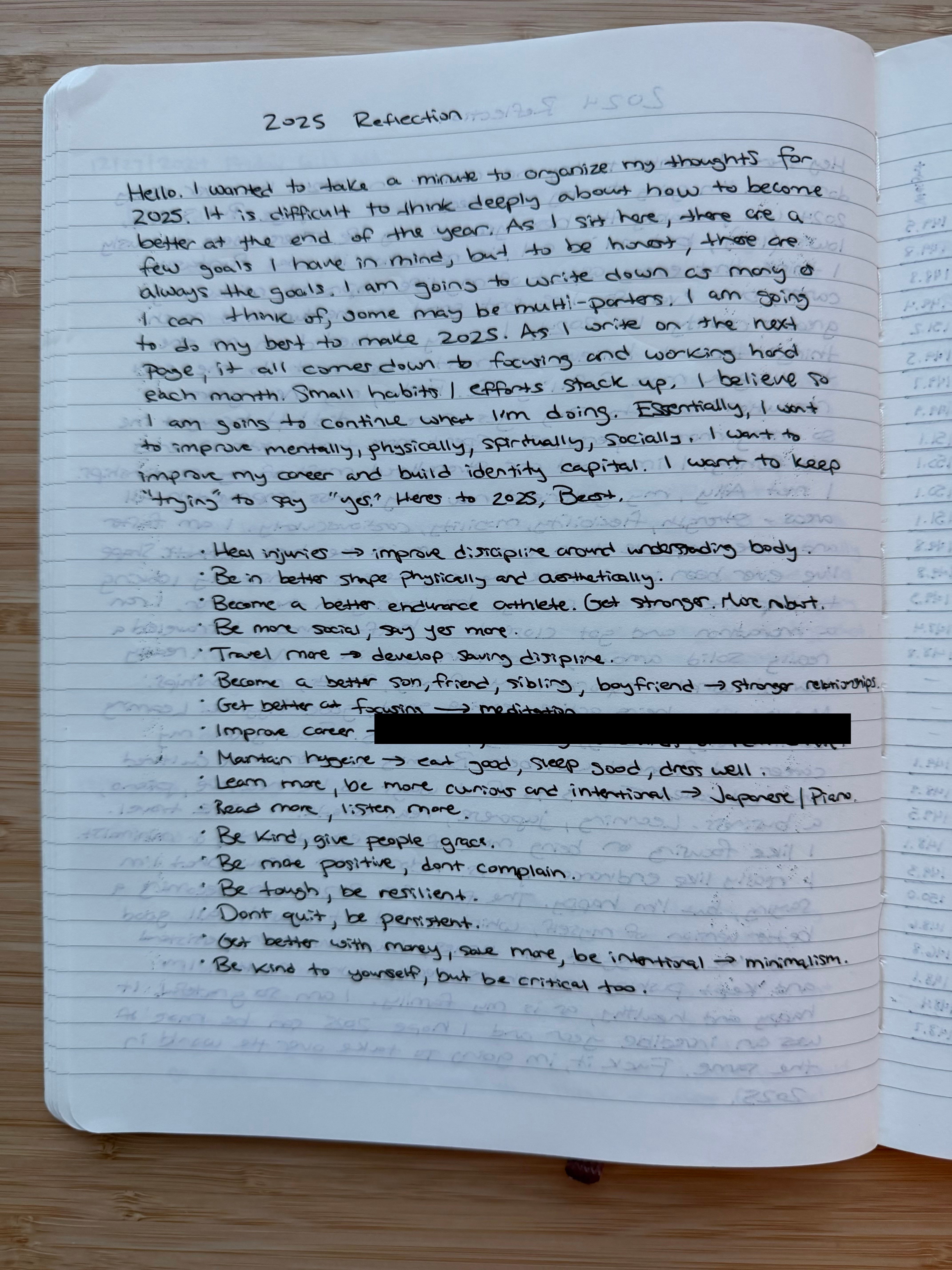
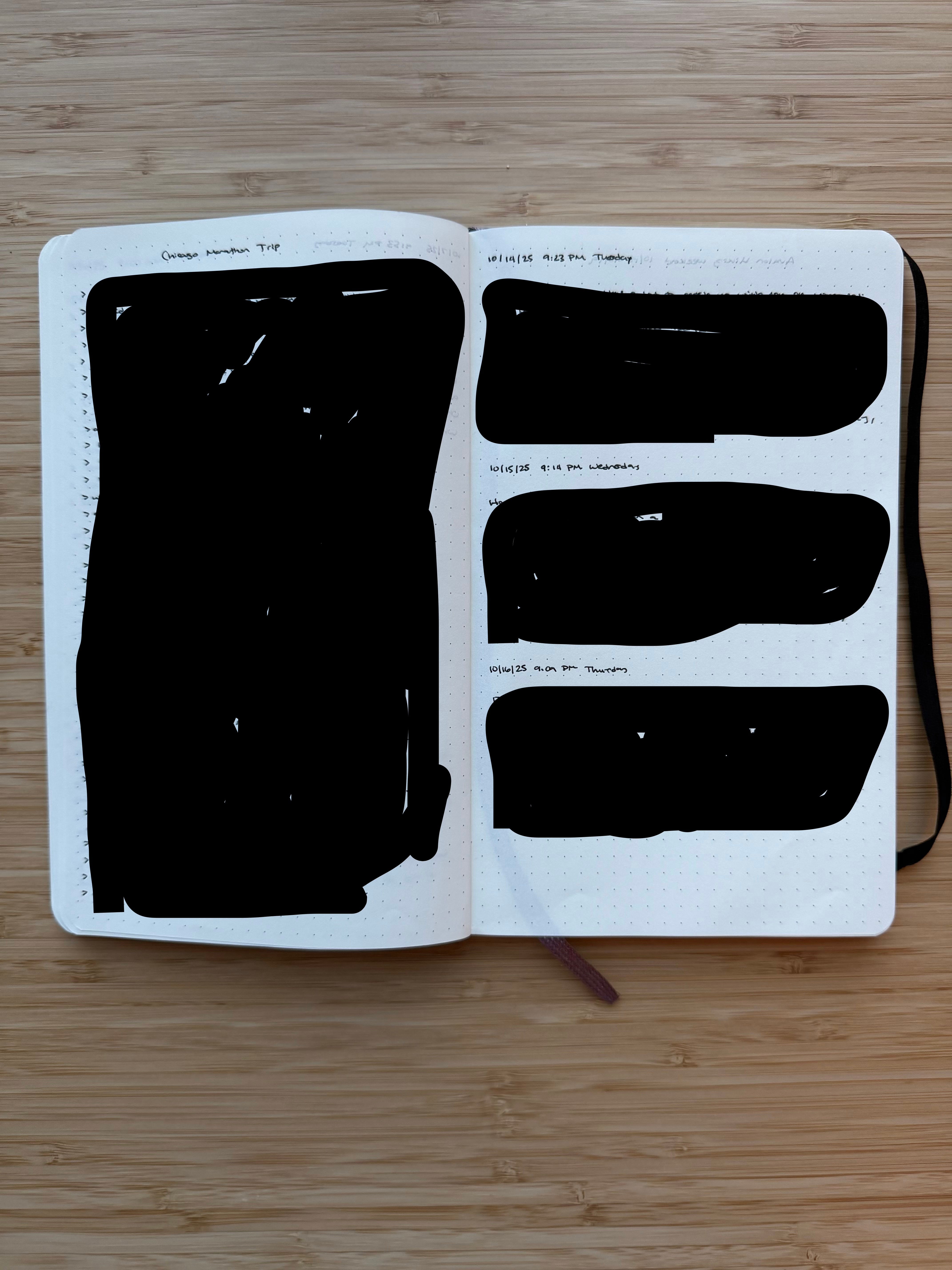
Examples of my journals are below.
The list of possibilities is infinite. When you design yours, be creative and make it fun. All of the examples seen at the end of this essay align with something I’m working towards. Daily tracking lets you focus on the now—controlling the inputs—without hyper-fixating on the end goal. The outcome isn’t in your control, but your actions today, are. You won’t one shot the boss in a day, but you can stack small daily habits to build something meaningful over time. Journaling is there to hold your hand along the way.
Brandon Sanderson—one of the greatest fantasy and science fiction authors of all time—often emphasizes that a satisfying story follows a transformative arc. The protagonist begins broken—battered by flaws, losses, or external forces—then progresses through trials that test and reshape them, culminating in a reflective payoff. The “I was broken but now I’m whole” moment. The looking back moment. The “look how far I’ve come.”
You’re writing your own story every day. So why not document it and have something cool to look back on?
Memory
How many times have you sworn to yourself that you’d remember, only to forget an hour later? The assignment you understood in class but forgot by the time you got home. The grocery list you filed away in your brain, only to realize when you got home that you forgot toilet paper. Maybe you chalk this up to shitty memory, maybe ego, maybe both. The point is, it’s really not your fault. You’re just using the tool you’ve been given incorrectly—you’re trying to use a star screwdriver on a flathead screw.
Whether you have S-tier memory or can’t remember how to spell Wednesday, the human brain isn’t designed to hang onto the details. It’s remarkable at getting the gist of things—at holding onto the outline of a memory—but extremely poor at remembering specifics. What makes this sad is that the tiny details are often what matter—really, it’s the micro-moments within the memory that makes things meaningful. Yes, you remember being happy on Christmas, on vacation, or on your birthday—but you don’t actually know why. You remember how you felt, that the trip was fun, but not much else. It’s actually all of the little things that happened on those days that made it worth remembering—and you remember none of them.
You remember your 20th birthday, but not dad’s tragically bad one liner? You remember the wedding, but not the 6 year old ripping the Fortnite dance for ten seconds?
It’s the culmination of 100s of little moments across an event that actually give you the feeling of excitement when you think back—journaling is a beautiful little time capsule that helps you capture these deep moments that are so easily forgotten.
Every night I write about my day because every day there are minuscule moments that are so awesome I want to remember.
12/23/25 - Girlfriend ate all of the cookie dough out of our ice cream and handed it to me like she did nothing wrong.
11/5/25 - Girlfriend dropped container of eggs and blamed me—we cracked up over it (pun intended)
9/7/25 – Had a sausage sandwich at the Steelers game and it tasted terrible, but we all pretended it was good
7/5/24 – Played DayZ until my eyes hurt with X, Y, and Z. We made it super far first run—went to bed at 4AM on the same day I ran a marathon.
6/3/24 – Went to the driving range and was smoking my 5 iron—probably hit 25 pure in a row which has never happened.
These are so stupid, but I’m happy just reading them—and they’re all memories I had completely forgotten.
It’s the details that make the memory. I want to be able to look back one day and remember the random moments that actually made me smile, and that alone is enough to force me to journal forever. Imagine years and years of these little moments captured, and the beauty of rereading them. Without my journal, these lovely, joyous moments that had me smiling ear to ear would be lost forever, and that makes me so sad. It’s not that you don’t remember these things happening—you just don’t think to recall them. As I read each of those above, I remember them all now, but I never would have had I not written about them. If you decide to write in a journal for any reason at all, I think it should be this.
Creative Outlet
Journaling isn’t strictly a productivity tool—it’s a way to express yourself, a way to let that dormant creativity run rampant. Draw pictures of plants and ugly self portraits. Practice a language and take notes on coral reefs. Tape photographs from trips and write poetry. Make calendars and conjure up plots and bar charts. Use the scientific method on a study about olive oil, or on yourself. There’s a million things you can do, which is what makes it so amazing. It becomes exactly what you want it to be.
We live in a time where we consume relentlessly, never releasing the pressure valve. Zero creation. Eating forever and never excreting. The world is struggling because no one is letting it out. If you have no means of creation in your repertoire, let journaling become your little force de resistance. A way to express what’s been lost through years of doomscrolling and chronic online-ness—your release, your outlet, your little way of saying fuck you to the regime. It’s difficult at first, but once you sit down for a few minutes, it gets surprisingly fun.
Self-Expression
Journaling sharpens your thoughts and improves self awareness. You become more comfortable with yourself and your ideas—what you do and don’t believe and how you want to portray yourself. There’s less guesswork which makes you more comfortable and confident out in the world. When you’ve already worked through your ideas on paper, you know what you want and where you should be going—and there’s no distractions. No need to put on performances because you believe with conviction in who you are. You’ve mapped out pitfalls of decisions and honed your own strategy for success. Then, when it’s game time, there’s no stagnation, no hesitation, just execution.
This newfound confidence and understanding makes you a better speaker. When you write, you’re forced to condense your ideas into what’s most important to keep the reader engaged. There’s no room for fluff and stuttering. You’re essentially practicing articulation and fluency, but through a different medium. This extrapolates into how you use life’s most sacred instrument—your voice.
It transcends into conversation and the mark you leave on the world. Self awareness and introspection are key to ping ponging with randos. You stop blurting shit out because you’ve already processed your thoughts privately. You become okay with not being the center of attention. You find yourself assessing the conversation objectively, almost from the third person, in the moment. You make way to be interested and not interesting, making you more memorable and unique than most.
Breadcrumbing
“Pages are more patient than people” - Anne Frank
When I first started, my journal was something I turned to when shit wasn’t going my way. A little tool to help me vanquish demons and work through challenges. It was absolutely beneficial—but I was hopping on one foot when I could’ve been running. I wasn’t perpetually in death spirals. I was happy a lot too.
Journaling is a way to breadcrumb yourself. Reflect and write when things are going well. Then, when you find yourself in the depths once more, you have a candy trail back to the top that’s catered directly to you. What were you doing when you felt good? You have a log. Matthew McConaughey talks about this at length—keep recording your life even when it’s good, and use those records as a playbook for future decisions.
Make it Fun
If you choose to give it a shot—don’t overthink it. Make it fun for yourself. Keep putting your ass in the chair because that’s when the movie gets good. Commit to 1 minute. Or 1 sentence. Write down your favorite part of the day. Write about what went well, or what didn’t. Capture cool moments and shit that made you laugh.
In my opinion, one of the keys to a fulfilling life is realizing your potential. I believe journaling is one of, if not the most powerful levers you can pull to support that process. I will do it for the rest of my life, without question, and I think you should too. I truly believe that journaling can can change your life, because for me, outside of exercise, nothing has been more beneficial than putting a little pen to paper.
Thank you for reading and godspeed.
- Dante
My Journals for Ideation/Reference:
Pen/Paper I Use
Muji Smooth Gel Ink Ballpoint Pen Knock Type 0.5mm
Moleskine Large Classic Notebook Dotted
Thanks for sharing <3
Beautifully written and in itself. I love hearing how journaling has changed your life for the better and how you don’t let special moments slip through the cracks. You truly seem to have found a key to life 🤍